
Track by Yuzo Koshiro


openRFC - Nova 1
As a hobby astronomer, space tech maniac, and sci-fi enthusiast, I want to give something back to the community. That’s why I decided to develop a computer for space applications partially using artificial intelligence.
The goal is to make it easy for anyone to build for under $1000, providing a great educational tool for dreamers or even professionals, and allowing hobbyists to practice programming spacecraft systems. If I can help even one or two brilliant minds learn the basics, it will have been worth it.
The project is still in its early stages. But once it’s ready, I will make the project files and documentation available as a royalty-free product.
I’m open to suggestions, ideas, and even criticism. Let’s build space technology together from our sheds!
+++The attached images represents the early phase of prototyping. Their only purpose to pre-visualize the upcoming final version.+++
Important note to all developers:
Don't rely 100 percent on AI when developing such boards or electronics. The current models often mistakes at calculations and sometimes hallucinates. Take their answers as hints and tips and always double check their technical suggestions.


FAULT-TOLERANT EDUCATIONAL SPACE COMPUTER - DESIGNED WITH THE HELP OF THE A.I.
This is not just a computer - it's a mission-grade educational platform.
Designed by the help of my A.I. assistant, Nova - with fault tolerance, modularity, and hands-on learning in mind. This custom-built system brings together the best of space-hardened architecture and experimental flexibility. The architecture closely mirrors principles used in real satellite onboard computers, offering both robustness and transparency for system-level learning.
CORE ARCHITECTURE
- Triple Motorola 68030 CPUs
- Operate in Lockstep Mode for fault detection via majority voting
- Hardware-level synchronization and parallel execution
- FPGA Central Logic (Xilinx Virtex-5)
- Handles address decoding, bus arbitration, fault voting logic
- Implements watchdog, expansion controller, and reset manager
- Memory Subsystem
- 16MB NOR Flash (S29GL128S90TFI020) with 22-bit address and 16-bit data bus
- Radiation-aware SRAM with 32-bit bus, ECC-friendly layout
- Redundant series resistor networks (2x 33 Ohm) for fault-tolerant bus signaling POWER AND RESET
- PMU with Sequencing - Safe startup for all voltage domains
- Controls reset timing for CPUs, FPGA, and memory
- Watchdog Logic (Dual System)
- Internal FPGA-based timer with heartbeat monitoring
- External discrete watchdog IC resets system if FPGA stalls
EXPANSION AND INTERFACES
- 3x DIN 41612 Expansion Ports (96-pin)
- Shared 32-bit A/D multiplexed bus
- SPI, I2C, UART, interrupt, chip select, and user IO lines
- All signals protected with TVS diodes and redundant resistor networks
- Fault Injection via DIP Switch
- 9-position manual fault injector for bus testing and error simulation
- Debugging & Testability
- Labeled test points for all major buses
- LED indicators for power, activity, fault, and status
- Future-proof connector layout for add-ons
SOFTWARE & FIRMWARE
- Boot monitor stored in NOR flash
- Verilog-based memory controller with read/write sequencing
- UART console interface for command and debug access- Firmware image supports memory tests, DIP fault detection, and expansion access
BUILT FOR:
- Embedded systems education and engineering labs
- Fault-tolerant computing courses and research projects
- CubeSat and space experiment prototyping
- Retro-computing exploration in a modern fault-safe context
DESIGNED LIKE SPACE HARDWARE, WITH THE HELP OF MY A.I. COPILOT: NOVA
This board reflects real-world mission system practices:
- Modular, testable, and observable architecture
- Radiation-aware layout and signal protection
- Bus redundancy and graceful failure modes
- Flexible enough to be both a dev board and a working flight-like computer
If you're serious about fault-tolerant systems, real-time logic, or learning how spacecraft think - this board is your launchpad.
Schematics, BOM, and build documentation coming soon
Contact me if you're interested in contributing, building, or collaborating!

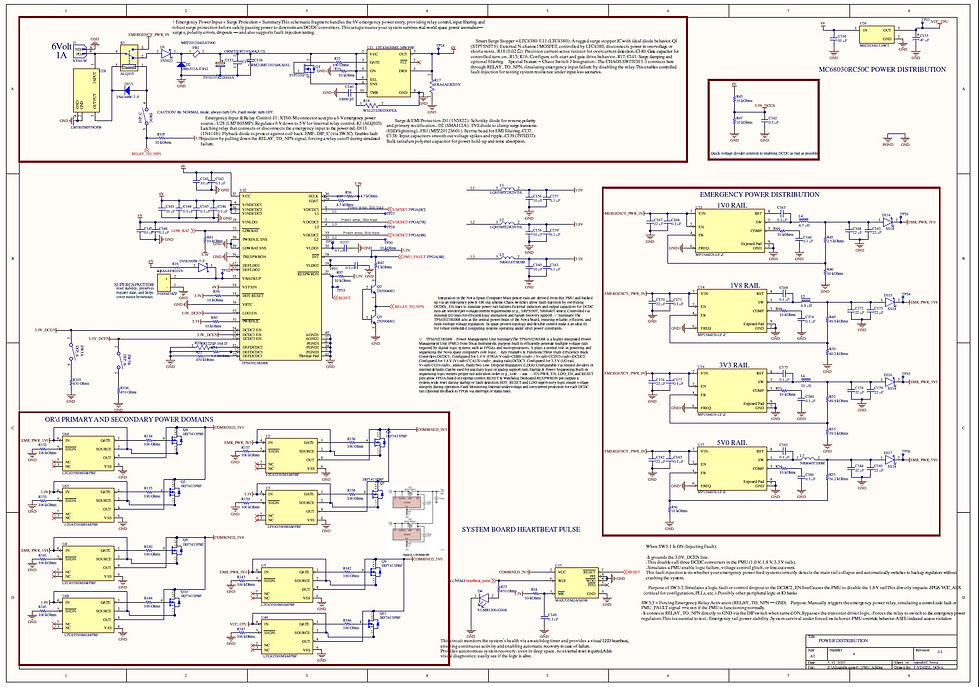
NOVA 1 SCHEMATIC SAMPLES



🚀 Nova Titan: A Resilient Space-Grade and Industrial Computer System
🌌 Overview
Nova Titan is a custom-designed, fault-tolerant computer system tailored for industrial, space and avionics applications. Engineered with robustness, scalability, and educational accessibility in mind, it combines high-performance FPGA processing, redundant architecture, and radiation-aware design to serve as both a real-world onboard computer and an advanced development platform.
🧠 Core Architecture
-
Triple FPGA Core
‣ 3× Xilinx Virtex-5 XC5VLX50T-1FFG665C
‣ Modular task distribution (e.g., main compute, I/O handling, AI acceleration)
‣ Redundant power and data buses
-
CPLD Watchdog and Fault Injection
‣ LCMXO2-256ZE-1TG100C as supervisory logic
‣ Manages resets, health monitoring, and fault simulation (Chaos Switches 1–3)
-
Memory Subsystems
‣ 3× RMLV3216AGSA-5S2#AA0 (SRAM)
‣ 4× MT41K256M16TW-107 IT:P (DDR3L SDRAM)
‣ 3× THGBMNG5D1LBAIL (eMMC storage)
-
Optical and Radiation Detection
‣ AFBR-S4N22P014M for fiberoptic interfacing
‣ BPW34 + comparators for radiation pulse monitoring -
Thermal Sensing
‣ 6× TMP451AIDQFR I²C temperature sensors
‣ Monitored by supervisory FPGA or CPLD
⚡ Power System
Designed for single-rail DC input (8–12 V) with distributed high-current regulation:
Output VoltageCurrent (max)PurposeRegulator
1.0 V30 A totalFPGA VCCINT (core voltage)MP86956GMJ-P ×3 (or 1 shared rail)
1.35 V4.4 ADDR3L SDRAMMP86956GMJ-P
2.5 V3.6 AVCCAUX, CPLD, misc I/OMP86956GMJ-P
3.3 V8.1 AVCCO, Flash, sensors, opticsMP86956GMJ-P
-
Ferrite bead filtering and ceramic/polymer capacitors ensure clean rails.
-
Dielectric immersion cooling possible — no electrolytics used.
🧩 Modularity
-
Power board is independent: Connects to mainboard via high-current connector (under review: terminal blocks or robust multi-pin headers).
-
Designed with test points, debug ports, and optional DIP switch chaos injectors for real-time fault simulation.
🛰️ Mission Profile and Applications
Nova Titan is ideal for:
-
CubeSats and small spacecraft OBCs
-
Avionics and harsh-environment controllers
-
Industrial environments
-
Educational and research labs exploring:
-
Radiation mitigation
-
Redundant computing
-
AI-based fault prediction
-
-
High school / university outreach: Can be built for <$1000 with proper guidance
🛠️ Current Status
-
✅ Regulator rails (1.0 V, 1.35 V, 2.5 V, 3.3 V) designed and reviewed
-
✅ Memory and thermal I²C bus mapped
-
✅ CPLD logic sketched for watchdog and chaos testing
-
🔄 Power connector and layout optimization in progress
-
🔜 Gerber generation, thermal simulation, and SPICE validation next

