Track by Yuzo Koshiro
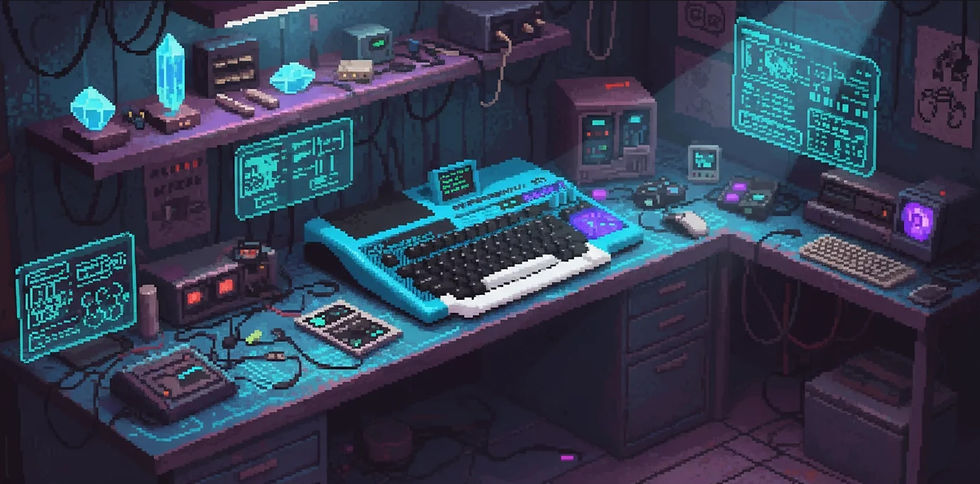

ACC-8000
It all began a few months ago when, while browsing a Hungarian online auction site, my eye caught a listing that included a strange-looking, unknown computer case. Since the starting price wasn’t high, I placed a bid, scrolled on, and forgot all about it. A few days later, I received a notification that I had won the item. Soon after, the courier delivered the package.
+++This is an early prototype, there can be imperfections in the overall design.+++


About the development
As it turned out, the mysterious case contained a rather rare Apple II clone. The ACC-8000 is a triple-processor business computer from the early 1980s, developed in Hong Kong.
Unfortunately, it was not a commercial success — only a few units were sold, and during the retro-computer revival it never became a cult classic.
The manufacturer — as often happens — disappeared without a trace, ceasing operations with no successor. Because of this, aside from a few brochures, no documentation has survived for this machine.

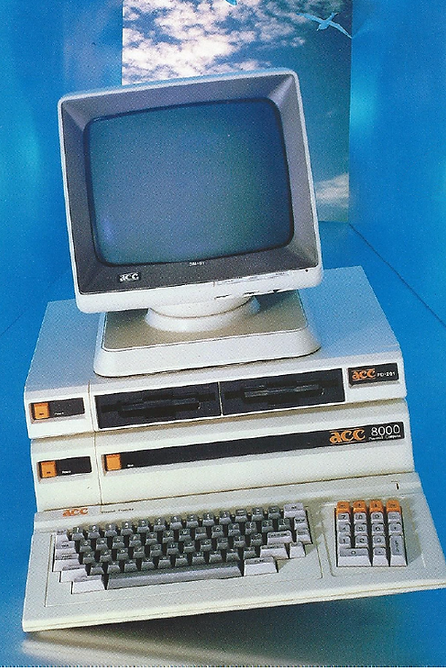

The motherboard contains three processors: a MOS 6502 running AppleDOS, the classic Zilog Z80 running CP/M, and a Motorola 6809 CPU running FLEX/OS-9.
On top of that, it came equipped with 128 KB RAM, 80-column text mode, a floppy controller, and RS-232C support — not to mention the expansion ports. In my opinion, it was the ultimate overkill Apple II clone of its time.
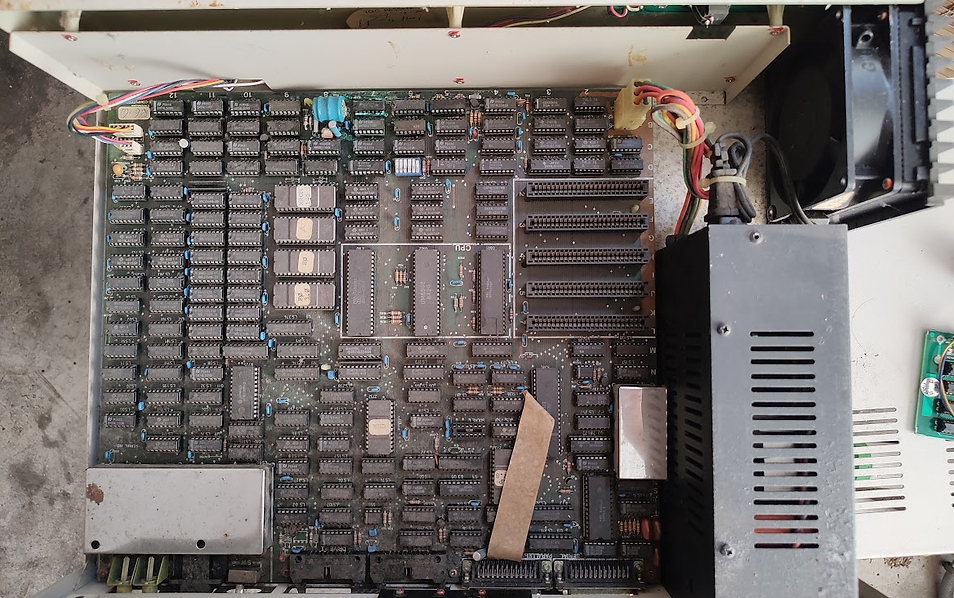
Unfortunately, the motherboard shows heavy acid damage caused by a leaked Varta battery. The board is beyond repair. So without documentation, only reverse engineering is the only way to rewive the dragon.

.png)
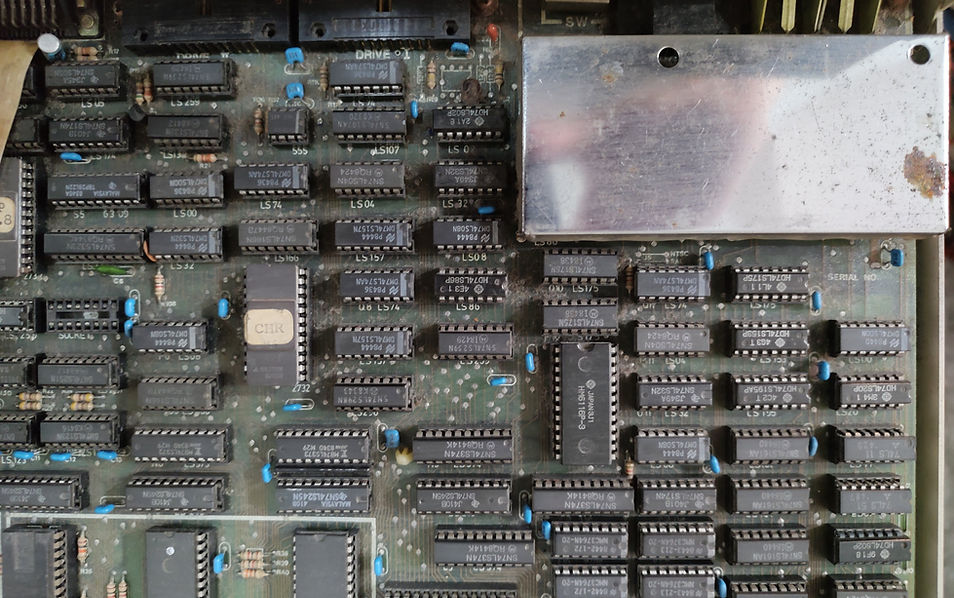
I managed to identify around 80% of the chips, but this didn’t help much, considering that the motherboard includes many logic ICs. Properly understanding it requires deep knowledge of retro circuit design — and some of the chips are extremely rare, meaning there's a high chance of mistakes during the process.
The second option for reviving the machine (though not very authentic) would be to integrate the original Apple II Plus schematic and various aftermarket processor and expansion cards onto one large motherboard, sacrificing a few expansion slots.
This is more feasible — in fact, I’ve already started — but it’s extremely time-consuming and requires a large number of ICs. Developing it would probably take 2–3 years, and by the end it’s questionable whether it would even be financially worth it.


The third option would be to integrate three Raspberry Pi Picos — or a cheaper FPGA and a HDMI controller chip — onto a motherboard. I’m leaning toward this because of lack of time and to save costs.
Of course, I started fantasizing about what such a machine would look like today or in the near future. So this machine also received the cyberpunk treatment.
While keeping its original dimensions, I wanted something more elegant and spaceship-like. Asymmetric shapes worked extremely well again.
I deliberately avoided concave edges and details to keep future plastic mold manufacturing as simple as possible. To ensure cost efficiency later, several structural elements are designed to be reused in multiple places.
For the initial mockup and experimental phase Fusion 360 works perfectly; later everything will be detailed in SolidWorks.


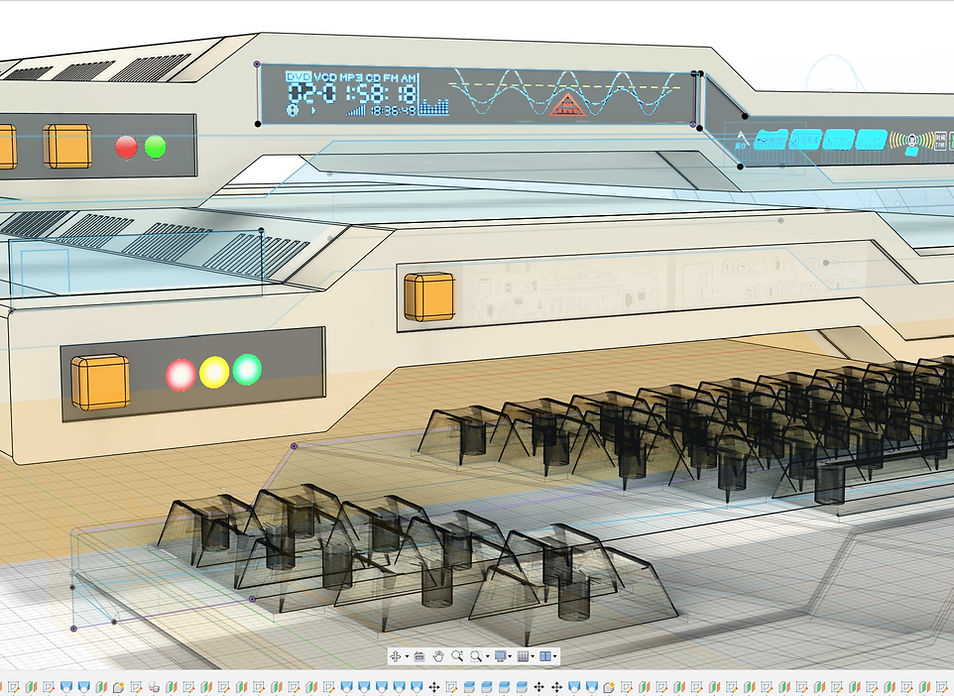
Honoring the legacy of the original ACC-8000, the new version would also include three systems. The first would be a RISC-V-based OS, for example with a Spacemit SoC. The second would be an Android system running on a Rockchip SoC. And finally, the third would be an FPGA with a freely selectable core.
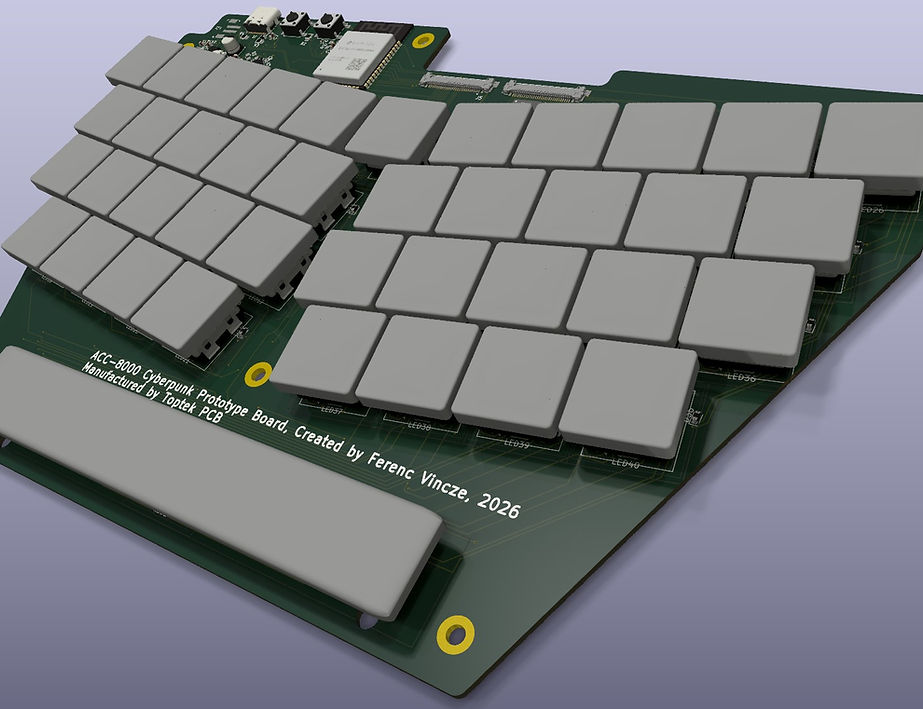
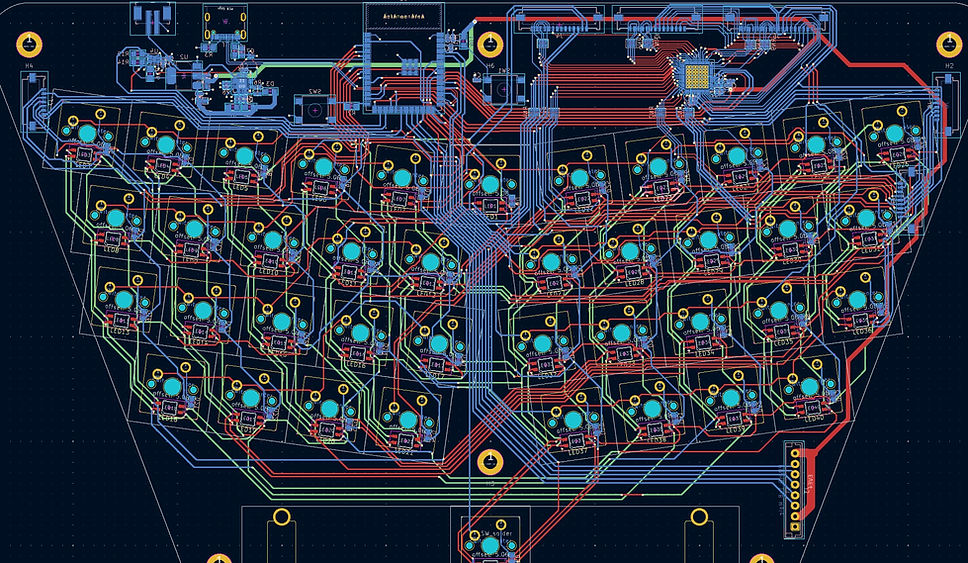
Here is a small schematic snippet of the keyboard mainboard, which contains a wireless ESP-S3 module with battery charger and connectors for the 3 keyboard daughterboards. I also implemented an RGB LED matrix driver with sideboard connectors.

Shortly after I started designing the control boards of the top - bottom platforms and the computer stand. They are identical for cost reduction reasons, but electronic components will be placed according to their functions. As a main microcontroller I choose the ESP32-S3. It will handle wireless connections, driving LCD displays, remote controller, limit switches and 4 larger DC worms geared brushless motors.


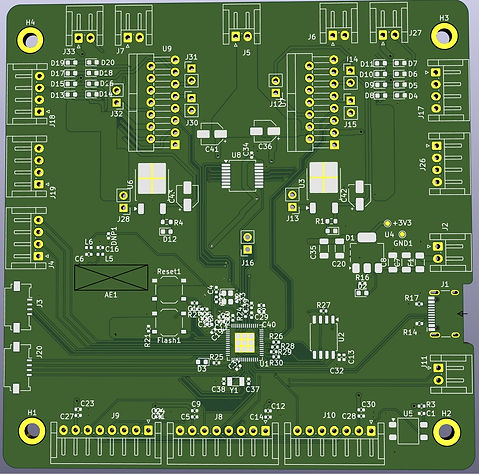
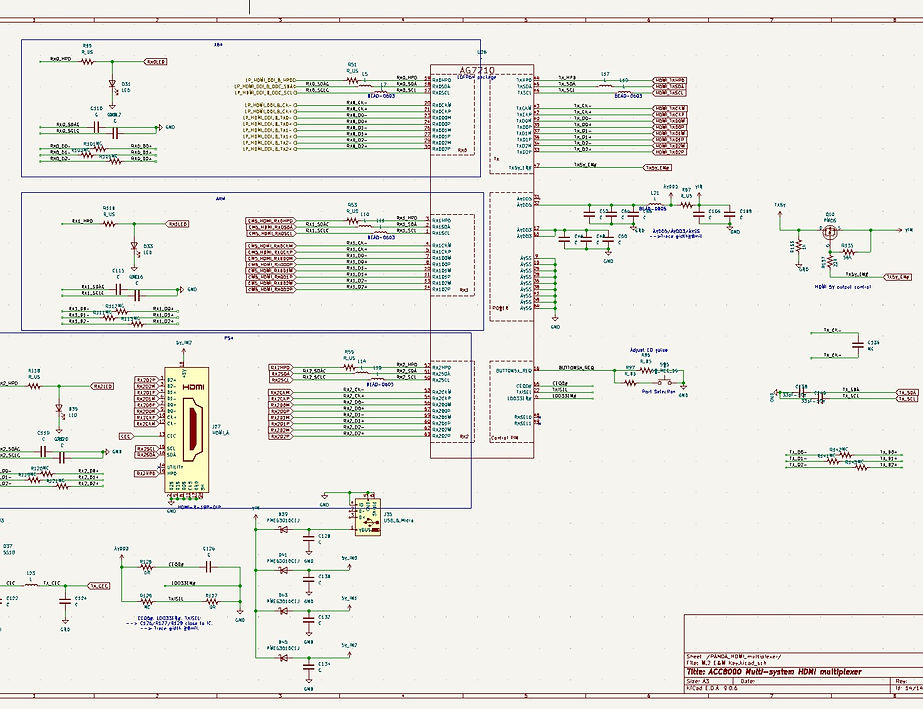
Since this is a multi-system motherboard, multiplexing the various outputs plays an important role. There is simply no place to implement so many connectors at the back of the modules, and think of it, it would be sooo confusing. So multiplexing is the only way. HDMI, USB, ETHERNET, SDMMC needs to be switched. I choose ESP32 again to send the commands depending on which system core is running. I carefully choose bi-directional de-multiplexer ICs to implement.
The finishing touch was the set of beautiful AI-generated images — breathtaking and drool-worthy at the same time. This machine is pure goosebump material.